In the previous three posts, I tried to demonstrate how Schindler's List is structured around exchange and valuation. That is, by looking at several key scenes, I tried to demonstrate that the film works via a series of A-in-exchange-for-B and A-is-greater-than/lesser-than-B.
Strictly speaking, this valuation/exchange matrix is structural, i.e. it isn't a primary means of purveying content. However, it is not entirely neutral either - by structuring the entire narrative on exchange and valuation, the overall effect of the valuation matrix is to establish the economy as the overarching (and hence wish-fulfilling, anxiety-relieving) aspect of reality - pre-traumatic, traumatic and post-traumatic. The relentless logic of reduction to exchange-value, while it could be read as a subversive potential of the filmic text, rather serves to institute the economy as the unifying element of history, holding together the world before, during and after the Holocaust.
In the coming posts I will analyze a particular segment of the valuation/exchange matrix that is not merely structural, that is in fact more content-charged, so to speak. I mean, I'd now like to turn attention towards an element of the valuation matrix that plays a greater role in signification, perhaps the greatest role. Specifically, I would like to examine the tripartite (masked as a mere dual) juxtaposition of diverse libidinal economies.
WTF?!
Exactly. So unlike the discussion of the valuation matrix, where I basically cut several cross-sections along the entire film, I would like to arrange the analysis of the libidinal economies model in a different way - starting from the core, and gradually working my way farther from the center, so as to prevent the claims I'm about to make from seeming too far-fetched. In order to do that, we'll start with what I condiser to be most obivious, and slowly work towards more daring interpretations and claims.
THE core of the film in this sense is the wedding/cellar/female-singer scene. It is precisely this scene that unfolds for the viewer three competing models of libidinal outlet - Schindler's, Goeth's, and in between, the Jewish third way. By use of cross-cutting, Spielberg shows the viewer a clandestine Jewish wedding that takes place in one of the women's barracks in Plasow; a female singer performing in Goeth's villa in front of Schindler and a crowd of SS-men; and Goeth talking to and then physically abusing Helen in his cellar.


First it should be noted that we are still very firmly on valuation-matrix ground - Spielberg collates three models of libidinal economy, nicely placed one next to the other. This juxtaposition necessarily evokes in the viewer a tendency to measure these models one against the other, to establish an order of value and worth; in this case, maybe not so much in the sense of worth-more/worth-less, but more along the lines of perverse (Goeth's sadistic relation with/towards Helen), hedonistic/promiscuous/commercial (Schindler) and normative/morally superior (the Jewish wedding).
This is truly the core of the competing libidinal economies axis, as it lays bare the tripartite character of the comparison. Elsewhere in the film, the role of the Jews is masked or sidelined, as the libidinal economies compete along the lines of the more dominant Schindler vs. Goeth dichotomy (mentioned in the previous posts), thereby bracketing the role of the Jews in the libidinal economy competition. It is therefore important to bear this in mind - as I later return to the role of the Jews in the signification structure of the film, we would do well to remember that they are in fact a crucial element in the libidinal competition, measured as they are against two gentile models of libidinal outlet.
If we look at this scene from a female point of view, Spielberg basically prescribes here three possibilities, three female alternatives:
1) The woman can either suffer male violence (the female Subject as a 'being-in-passion' - passion in the sense of suffering the action of another, in this case a male Subject... in other words, rather as a female object, not so much as a Subject, of male brutality).
2) The woman can become the Object of the male gaze - specifically, as a commodified, stylized item that a male Subject (or audience) can enjoy.
3) Or, finally, the woman can submit to matrimonial protection.
Indeed, seen from the perspective that Spielberg offers here, it appears that the female Jewish newly-wed is the better off of all three females.
However, what is precisely the position of the female Jewess within the framework of marriage?
On the surface of things, Spielberg constructs an extremely egalitarian, almost ultrafeminist setting. Instead of a male rabbi, a woman is the one who recites the blessings and presides over the wedding. In fact, the groom is the only male inside the barrack - in stark contrast with the Schindler-singer scene, where the singer on the stage is the only female person in the hall. Furthermore, the visual subjectivity of the wedding scene contrasts with the male scopophile aspect of both the Schindler-singer and the Goeth-Helen scene: whereas Helen and the singer are both examples of passive objects to one-sided, hierarchical male 'gazes' (where it is quite clear that only the male has the power to enjoy looking at the female, and not vice versa; where the viewer sees the scene exclusively via male eyes), the wedding scene comprises of a multilatteral view - the newly-weds are surrounded by the female crowd from all sides, and the viewer "sees" the scene from multiple, gender-unspecified points of view.
However, as in several other moments in the film, the audio gives away the key to a full understanding of the visual representation.
There are at least 7 blessings (actually more like 9 or 10) that must be recited during a Jewish wedding, and the filmmaker chose to represent the following single blessing in this scene:
Baruch ata Adonai Elohaynu melech ha’olam asher kidshanu bemitzvotav, vetzivanu
al ha’araiyot, ve-asayr lanu et ha’arusot ve-hitir lanu et hanisu’ot lanu
al yidei chuppah ve-kiddushin. Baruch ata Adonai, mekadaysh amo Yisrael al
yeday chuppah ve-kiddushin..
I include two alternative English translations below (one is from Halakha.com the other one I found somewhere on the net, can't remember where):
Blessed art Thou, O Lord our God, King of the Universe, who has sanctified us by his commandments and has commanded us concerning the forbidden relations and has forbidden unto us the betrothed and has allowed unto us the wedded through [the marriage] canopy and sanctification.
Praised are you Adonai, Ruler of the universe, who has made us holy through Your commandments and has commanded us concerning sexual propriety, forbidding to us (women) who are merely betrothed, but permitting to us (women) who are married to us through chuppah and kiddushin. Blessed are You, Adonai, who makes your people Israel holy through chuppah and kiddushin.
First of all, anyone who still had doubts whether this scene (and the film in general) is about libido and how it should be handled, surely cannot contest that via the very text of the blessing, even the manifest content of this scene (although most viewers, who do not understand Hebrew, are unaware of it) relates directly to prescriptions and proscriptions of who is and isn't a legitimate object of male libido.
Second, contrary to the seemingly feminist setting (again, exclusively female company other than the groom, a woman presiding over the ritual in lieu of a rabbi), the text of the text of the blessing places us firmly on male exclusivist, patriarchal (not matrimonial) grounds.
If the "Jewish way" proposed by the filmmakers is the legalistic circumscription of libido within clear boundaries ("you can have your way with these, but hands off these-a-ones"), then the Schindler, i.e. Christian/Catholic way, is represented in the on-stage singer scene.
I've already pointed out the male-gaze and commodification aspects of the scene, but it is worthwhile noting in passing that it's symbolism does suggest or reinforce a reading that sees it as specifically Christian. Again, the audio comes to our aid - with the singer's song, Julian Tuwim's (the Jewish Tuwim) poem Milosc ci wszystko wybaczy:
Miłość ci wszystko wybaczy
smutek zamieni ci w śmiech
miłość tak pięknie tłumaczy
zdradę i kłamstwo
i grzech....
And so we have here they very well known iconography which contrasts the legalistic, proscriptive Jewish god, with Christ, the god of Love - that proffers forgiveness and comfort, that redeems betrayal, lies and sin (just quoting the song... google-translate it if you think I'm bluffing).
But that is by far not all there is to the Schindler/Christian way.
One can better realize what is at stake by examining Schindler in contrast with Goeth. And indeed it is this libidinal duo that frames the entire film - with the Jews sandwiched in between, thereby feminized through the framing constituted by two males.
Goeth is driven to violence by his inability to kiss Helen, by an inability to break the taboo, transgression against the National-Socialist proscription.
On the other hand, Schindler kisses every and any woman - as is demonstrated by the scene that follows immediately on the wedding/singer/cellar scene:


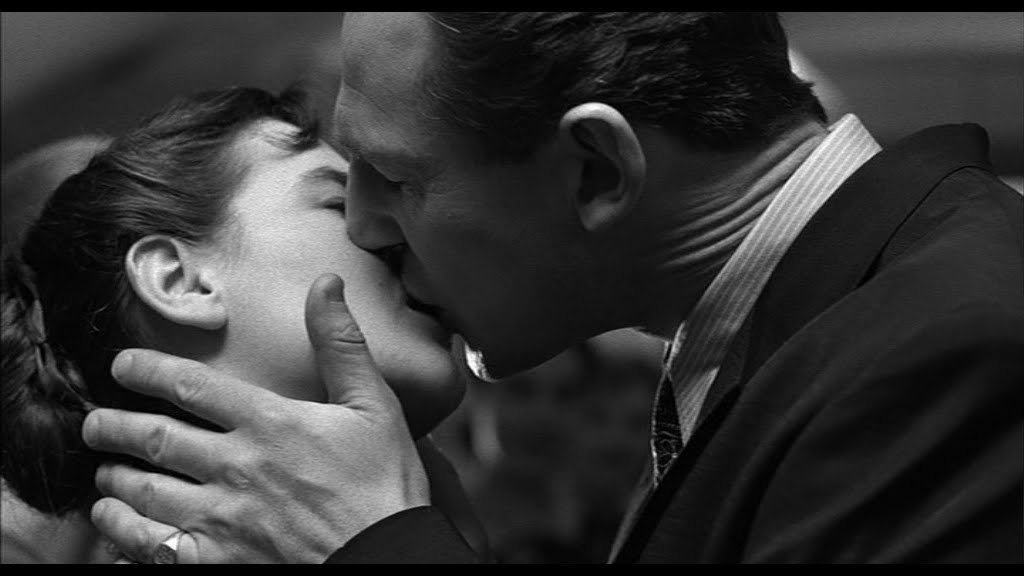


Schindler heeds only the voice of the Big Other - he enjoys all and any women; the super-ego's prohibitions, which torment Goeth, are completely foreign to him, as is the Symbolic proscription embodied in the so-called Mosaic Law.
As a matter of fact, Schindler will not even stop at the racial boundary, as he proceeds to kiss the Jewess factory worker, to the dismay and discomfiture of everybody around him.


Goeth in particular, cranes his neck to get a better view, as if he was asking himself: "That Schindler... how does he do it?" - for Schindler has no qualms to go ahead and do in public, that which Goeth could not do in the "comfort" and secrecy of his own cellar.

Enough for now, as this post is becoming too long, again.
I'll pick up here again next time, to examine more closely a few examples of the dual contrast and opposition between Schindler and Goeth's libidinal economies - and also say a few words about the cellar scene with Goeth and Helen.


